Turn your study materials into practice.
Upload your lecture slides, readings and notes. themindra turns them into summaries and flashcards cited to your own material, then has you answer from memory before it shows you the source.
No card needed · Your uploads stay private
 Home
Home All sources
Subjects
← Biology
Cardiac physiology, lecture 4
cardiac-physiology-l4.pdf · 18 slides · 24 flashcards
 Summary
 Flashcards
 Source
Card 7 of 24
Cardiac physiology, lecture 4
Why does the AV node delay the electrical signal?
Your answer
So the atria can finish contracting and empty into the ventricles before the ventricles contract.

You recalled it
Your answer matches what your source says.
From your source · Slide 13
The AV node delays conduction by roughly 0.1 seconds, allowing the atria to empty fully into the ventricles before ventricular contraction begins.


cardiac-physiology-l4.pdf
Slide 13 Slide 13
The atrioventricular (AV) node
Located in the interatrial septum, near the opening of the coronary sinus.
The AV node delays conduction by roughly 0.1 seconds, allowing the atria to empty fully into the ventricles before ventricular contraction begins.
From the AV node, the impulse passes to the bundle of His and the Purkinje fibres.

What the research says
Rereading your notes feels productive, but decades of studies point the other way. themindra is built on the two study habits with some of the strongest evidence behind them: pulling answers from memory, and coming back to them over time.
61
studies compared testing yourself with rereading. Testing came out ahead for later recall, most of all when you had to recall the answer rather than recognise it.
Rowland (2014), Psychological Bulletin
 Rowland (2014), Psychological Bulletin
5,374
students took part in 50 classroom experiments. Retrieval practice helped across school levels, subjects and test formats.
Agarwal, Nunes & Blunt (2021), Educational Psychology Review
317
experiments compared spreading practice out with massing it together. Spreading it out came out ahead.
Cepeda et al. (2006), Psychological Bulletin
1 year
was the longest test delay in a study of more than 1,350 people. The best gap between sessions grew with how long they needed to remember.
Cepeda et al. (2008), Psychological Science
Why rereading feels better than it works
In a classic experiment, students who reread a passage did better on a test five minutes later. Students who practised recalling it did better two days and a week later. Recall feels slower in the moment, and that effort is what makes it last.
Rereading
- Feels fluent while you do it
- Easy to mistake for knowing
- Fades once the page is gone
Recalling from memory
- Feels harder while you do it
- Shows you what you actually know
- Lasts longer
Roediger & Karpicke (2006), Psychological Science; Soderstrom & Bjork (2015), Perspectives on Psychological Science
A little, often beats a lot, once
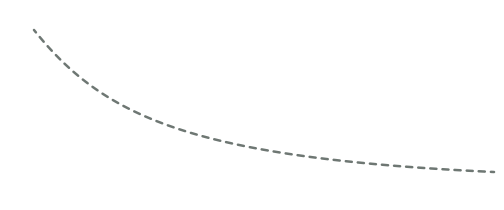
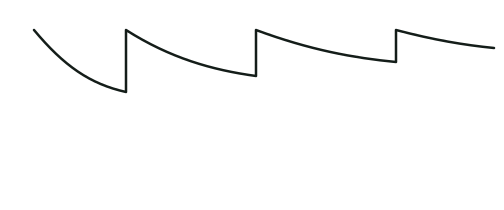
Spreading the same amount of practice over several days leaves more remembered later than doing it all in one sitting.

 ReviewReviewReviewTimeRemembered
 Spaced practice
 Cramming
Illustration of the spacing effect, not data from one study. Based on Cepeda et al. (2006, 2008).
Why it works
themindra is built around how people actually remember: you work from your own material, retrieve it from memory, and check what you got against the source.
Every answer leads back to your source
themindra never adds outside facts or corrects your material with its own. Summaries and flashcards point to the exact passage they came from, so you can always check.
- Built only from what you upload
- Each point linked to its passage
 Built only from what you upload
← Biology
Cardiac physiology, lecture 4
cardiac-physiology-l4.pdf · 18 slides · 24 flashcards
 Summary
 Flashcards
The cardiac conduction system
Sinoatrial (SA) node: the heart's natural pacemaker in the wall of the right atrium; it starts each heartbeat.
Slide 12Atrioventricular (AV) node: delays the signal by about 0.1 s so the atria finish contracting before the ventricles.
Slide 13 Slide 13
Bundle of His and Purkinje fibres: carry the impulse quickly through the walls of the ventricles.
Slide 14ECG waves: the P wave shows atrial depolarisation; the QRS complex shows ventricular depolarisation.
Slide 16From your source · Slide 12
The sinoatrial (SA) node, a cluster of specialised cells in the wall of the right atrium, generates the electrical impulses that set the heart's rhythm. It is often called the heart's natural pacemaker.
Answer from memory first
Typing an answer from memory takes more effort than picking one, and that effort is what makes it stick. Answer choices are there as an optional hint when you are stuck.
- Your answer checked against the source
- Choices only when you ask for them
Card 8 of 24
Cardiac physiology, lecture 4
Which part of the conduction system is the heart's natural pacemaker?
Answer from memory, in your own words…
Choices
Optional hintPicking from choices is easier than recalling, so a choice you get right counts as “recognised”, not “recalled”.
Progress you can trust
See how many cards in each Topic you have learned, are still working on, or keep missing. Your Streak counts the days you practise, as a habit, never as a score.
- Learned, encountered and missed, per Topic
- A Streak that rewards showing up
Biology
6 sources · 3 topics · 142 flashcards
Progress by topic
Cardiac physiology
38 of 52 cards learned
Cell biology
21 of 44 cards learned
Genetics
9 of 46 cards learned

12-day practice streak
You've practised today. Come back tomorrow to keep it going.
Why not just use a chatbot or a flashcard app?
Both have their place. themindra does one job: turning your own course material into practice that checks you, and showing where every answer comes from.
| tthemindra | AI chatbotse.g. ChatGPT | Flashcard appse.g. Anki, Quizlet | |
|---|---|---|---|
| Built from your own course materialSummaries and flashcards come from what you upload. | Only from your uploads | Mixes in what the model already knows | You write cards, import a deck, or generate one |
| Every point cited to your sourceCheck any card against the passage it came from. | Linked to the exact slide or page | Rarely, and hard to check | Usually no link back to your notes |
| You answer from memoryRecalling an answer beats recognising it. | Type first; choices only as a hint | Only if you ask it to quiz you | Often flip-and-reveal or multiple choice |
| Your answer is checked for youKnow whether you were right, and why. | Checked against your source | Checked against the model's own knowledge | Often you mark yourself |
 Only from your uploads
7 days free · No card needed
How themindra puts it to work
Every part of a practice round maps to a finding from the studies above.

Recall before you recognise
Every flashcard asks you to type the answer from memory first. Answer choices are only an optional hint, because recalling an answer does more for memory than recognising it.
Evidence: Rowland (2014); Kang, McDermott & Roediger (2007)

Feedback from your own source
After each answer you see the passage it came from, so mistakes get corrected and lucky guesses get confirmed.
Evidence: Butler, Karpicke & Roediger (2008); Kang, McDermott & Roediger (2007)

Getting it wrong still helps
Attempting a hard question before you know the answer helps you learn it, as long as the right answer follows. So themindra always shows it, even after “I don’t know”.
Evidence: Kornell, Hays & Bjork (2009)

A little, often
Spreading practice over days beats cramming it into one sitting. Your Streak nudges you to practise a few cards each day, so your practice spreads out.
Evidence: Cepeda et al. (2006, 2008)
A better learning loop
From source to understanding.
Not another place to collect notes. A place to put your knowledge to work.
- 01
Bring what you’re learning
Upload a PDF, plain text, or Markdown file. Give it a home in a subject and topic.
- 02
Make it easier to study
Create a source-based summary and flashcards. Choose what you want to work on next.
- 03
Recall. Check. Repeat.
Answer from memory, check against your source, and come back to the concepts that need practice.


01 / A home for your learning
Less scattered.More connected.
Keep the material you want to understand in a workspace that makes sense to you. Subjects, topics, and sources stay together, so picking up where you left off is simple.
- Organise sources by subject and topic
- Upload PDF, plain text, or Markdown
- Return straight to your recent learning
 Organise sources by subject and topic

Anatomy
1 source · 6 flashcards

Drag a file here, or browse
PDF, plain text, or Markdown · up to 100 MB

Mousse joints in the upper limb
35 KB · Added Oct 14, 2026

Acromioclavicular Joint: A plane type synovial joint between the lateral end of the clavicle and the acromion of the scapula...
 Summary · Ready
 Create more
Mousse joints in the upper limb
mousse_joints-in-the-upper-limb.pdf · 35 KB · 6 flashcards
 Summary
 Flashcards
 Source
Summary
Created Oct 14, 2026
Joints in the Upper Limb
Acromioclavicular Joint: A plane type synovial joint between the lateral end of the clavicle and the acromion of the scapula, lined with fibrocartilage, allowing axiolateral and anteroposterior movement.
Shoulder Joint (Glenohumeral Joint): A ball and socket synovial joint covered in hyaline cartilage, allowing extensive mobility. Movements include extension, flexion, abduction, adduction, and rotation.
Elbow Joint: A hinge-type synovial joint connecting the upper arm to the forearm. It allows flexion, extension, and pronation, with strong collateral ligaments for stability.
 Page 1
02 / Understand the essentials
The key ideas.Still tied to the source.
Give dense material a clearer starting point. Read a structured summary, revisit the original source, and keep the context behind what you’re learning.
- Clear, readable summaries of your material
- Source pages kept close at hand
- Summary and flashcards in the same place
03 / Put your knowledge to work
Don’t just recognise it.Recall it.
Reading can feel like knowing. Flashcards ask you to go one step further: answer from memory in your own words, then check what your source says.
Card 1 of 6
Biology / Anatomy
What type of joint is the Acromioclavicular joint?
Your answer
A plane type synovial joint.
Enter to check
← Previous
← → to move between cards
Skip →Think before you check
Type what you remember, not what you recognise.
Get a little help
Show choices or say “I don’t know” when you need to.
Keep learning
Move through your cards and return for another round.


04 / Know where you stand
A clearer pictureof what’s sticking.
See your practice take shape, one round at a time. Answer outcomes and topic progress help you tell the difference between material you’ve seen and knowledge you’ve learned.
- See correct, partly right, and incorrect answers
- Track learned, encountered, and missed cards
- Build the habit with a daily practice streak

Every round is a step forward
4 rounds finished since Monday
This week

Progress by topic
Anatomy
0 of 6 cards learned
Learned means answered correctly twice in a row.
Made for your focus
Your focus. Your atmosphere.
A clear workspace in light, dark, or system mode. The same learning flow, in the setting that suits you.
Mousse joints in the upper limb

 Summary
 Flashcards
 Source
What type of joint is the Acromioclavicular joint?
Mousse joints in the upper limb

 Summary
 Flashcards
 Source
What type of joint is the Acromioclavicular joint?
 A little more daylight
 A little less distraction
A few more things
Good questions.Clear answers.
Get to know the workspace before you make it your own.
What can I upload to themindra?


Upload PDF, plain text, or Markdown sources up to 100 MB. Support for images, video, and sound recordings is coming. Organise sources under subjects and topics, then choose whether to create a summary, flashcards, or both.
How do summaries relate to my sources?
A summary is made only from the source you uploaded, and it shows the pages it is based on, so you can always go back and check the original.
How does flashcard practice work?
Each card asks a question. Type your answer from memory, then check it against what your source says. If you’re stuck, show answer choices or say “I don’t know” and see the answer.
What counts as a learned card?
A card is learned once you answer it correctly twice in a row. Cards you haven’t answered yet, or got right once or partly right, count as encountered, and a card whose last answer was wrong counts as missed.
Can I switch between light and dark mode?
Yes. Choose light, dark, or follow your system setting from the sidebar at any time.
Make what you learn stay with you.
Start with one source. Find the key ideas. Try your first flashcard.
Your next learning session starts here.
